Frankie reflects on 35 years at St Luke’s as she says a fond farewell

It’s hard to imagine St Luke’s without the inimitable Frankie Dee, a dedicated and inspirational nurse whose wealth of hands-on experience and management knowledge led her to become our Head of Quality and Compliance, monitoring, safeguarding and promoting the high standards of end of life care we offer patients and their families.
But, after 35 years, Frankie says the time has come to say a fond farewell to the organisation she has proudly helped to be the best it can be, and to the career that has taught her so much about what’s really important in life.
“It’s going to be strange, but it feels right. I feel proud of my achievements but it’s time to leave the baton for someone else to pick up. I’m 68 and I’ve stayed on an extra two years. Now I need to spend some time with my husband,” says Frankie, who is retiring exactly 50 years after she began nursing back in 1975.
It was during her training, while she was still a teenager, that Frankie discovered a passion for improving end of life care when she nursed a young mother with cancer.
“I realised there was something very wrong with how we were caring for people who were dying. I was 19 and I was looking after Gloria, who was 26 and had sarcoma. She’d had successful treatment and then decided to have a child, but the sarcoma returned.
“I nursed her in the last weeks of her life on a medical ward in Canterbury. She used to scream and cry in agony. That was because at that time doctors were so scared of patients becoming addicted to medication, so they weren’t controlling her pain. I was young but I knew that couldn’t be right. She died when her little boy was three months old.”
That unshakeable sense that there had to be a better way stayed with Frankie and has driven her ambition to support change through the years, standing firmly behind St Luke’s aim that no one should die alone or in pain.

Born in Africa, Frankie was eight when the family moved to the UK, living in Yorkshire, then Kent, where she started nursing. After her daughter was born Frankie kept up her practice, working in care homes, for a nursing agency and in a mental health hospital. She moved to Plymouth and for the first time she was able to pursue her interest in hospice care.
Frankie wrote to St Luke’s asking if they had any vacancies. They didn’t straight away but about six months later she was invited in for a chat and accepted a job in the inpatient unit.
“It was about 18 months after St Luke’s moved from Syrena House to the new building at Turnchapel. It was a much smaller place then. They had day care and 20 beds, but there was no community team and no hospital team. Community care was provided by Marie Curie or Macmillan nurses based in the GP practices,” explained Frankie, who started part-time on the IPU because she wasn’t sure she would like it.
“I was worried that it would be too much death and dying. It took me a while to adjust to the fact that it’s all about living. I think you need around six months to settle in to what it’s really about, picking up knowledge from the more experienced people around you, working as part of a team.
“Being at St Luke’s has taught me so much. I don’t worry about things that used to bother me. I realised what is not important. Instead of fretting about paying the electricity bill, it’s important to remember not to go to bed feeling angry with someone – you don’t know if they will be there to say sorry to tomorrow.
“Witnessing the pain that other people go through is a very good teacher. I mainly learned that from being with patients and their loved ones. It is their regrets that touch you. Don’t wait to do things – do what you can now. Don’t leave anything – just do it.
“It’s not a job you can leave behind at the end of your shift, but it’s about getting a balance and not taking it all home with you. You also have to accept that if you go to a party and someone asks where you work, it’s either a conversation stopper or people want to tell you their story, sometimes getting quite emotional.”
When Frankie first joined St Luke’s in 1990 there was very little regulation; each independent hospice did what they thought was right for their local community.
“St Luke’s developed to support the community we are based in. When people first started working for the hospice they often didn’t know if they would be paid at the end of the week and nurses would do the cooking as well as the caring.
“By the time I arrived, St Luke’s was already a well-loved local charity. It’s amazing what has been achieved over 35 years. Almost everyone in Plymouth now knows someone who has been helped by us.”

Frankie started as a staff nurse in the inpatient unit, quickly becoming a primary nurse in charge of four beds, progressing to junior sister, sister, then moving into management as Head of Nursing, Head of IPU, Director of IPU, before eventually taking on her current post as Head of Quality and Compliance.
“All that is thanks to my husband, Graham. I loved having contact with the patients, but he said I had to think about how many more people I could have an impact on by gaining experience and education.”
So, Frankie achieved a degree in palliative care at Cardiff, and both a Masters and Doctorate in Evidence Based Healthcare at Oxford – all studying part-time at home while continuing her day job.
“I did it to understand the underpinning knowledge of why we do things the way we do. I haven’t driven change at St Luke’s, but I have had input into it.”
For more than 30 years Frankie has also been St Luke’s registered manager for the Care Quality Commission.
“I’ve done this from day one when the CQC was first set up. At the time I was a sister and had broken my arm so couldn’t carry out my usual duties, but I still came into work to do some admin. I recognised that the CQC had started insisting on all these regulations for health services, and we hadn’t twigged yet. So I was given the role of working out exactly what we needed to do, and I’ve done that ever since.”
She has seen attitudes in the medical world change so that palliative care is now accepted as an important part of healthcare but she says there’s still a long way to go for the community to catch up.
“Try talking about death and dying in the pub you will lose a lot of friends,” she says.
Frankie believes a fundamental shift began with the formation of the NHS in 1947.
“People died at home because they couldn’t afford to do anything else. Families and communities used to support each other, and it is something we have lost. That’s why St Luke’s having a community service that can go out and support people is key. We expect people to take on a lot of responsibility without a lot of support and sometimes it is too much for them.
“I think people want to be at home, and that’s fine while we can manage their symptoms there, but if we can’t, then our inpatient unit is there to help. Not as a long term unit – it’s about crisis intervention.
“People do still think of the hospice as a place where people come to die. Sometimes they do, but the aim is to get them back home or into residential care where they can be comfortable. It is much easier to manage people in the community.”

Frankie has witnessed some unbelievably special and touching occasions at St Luke’s over the years.
“We had a young tiger visit once from Dartmoor Zoo. The chef in the kitchen was married to one of the keepers and they brought the tiger in. I don’t think you’d be able to do that now!”
She recalls dancers from the Birmingham Royal Ballet visiting and how singer Daniel O’Donnell sent flowers and a lovely letter to one of the patients, who was a big fan.
“It is these things that make a real difference. We are good at finding the things that matter to patients and making them happen. These experiences are all about living and emotional support and treating a patient as a whole person, not as their disease.
“Our care is about the spiritual, emotional, psychological and physical. All of those, if not addressed, will cause pain.”
She was also here for two visits by King Charles (then the Prince of Wales).
“I had to take him round one of the four-bed units and one of our ladies was so excited to see him. She had had her hair and make-up done specially.
“He was talking to her and one of his aides came up tapping his watch to say it was time to move on. Charles stood up, then sat back down to carry on the conversation with the lady. It made her day. At the time we had a hospice dog called Teddy, and he went up to Prince Charles with a stick wanting him to throw it.”
Frankie is looking forward to having more time to spend with her family, but says it’s the people who work for St Luke’s that she is really going to miss “because they are such a great bunch.
“They are so enthused about palliative care and wanting to make it the best it can be. My most recent role has been a real bonus. It’s given me a much wider understanding. All of us have the same goal. It doesn’t matter which department you are in – be it clinical, fundraising, facilities, retail – everyone cares.”
 https://www.stlukes-hospice.org.uk/wp-content/uploads/2026/08/Daves-Story-Blog-Header.jpg
733
1030
Charlie Carlyle
https://www.stlukes-hospice.org.uk/wp-content/uploads/2022/12/st-lukes-hospice-plymouth.svg
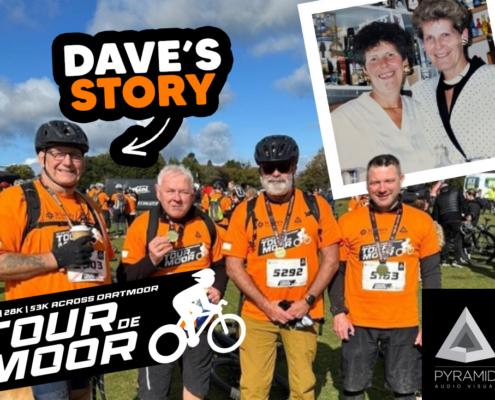
Charlie Carlyle2026-10-21 10:49:262026-10-21 10:49:26River rides Tour de Moor in memory of his grandad
https://www.stlukes-hospice.org.uk/wp-content/uploads/2026/08/Daves-Story-Blog-Header.jpg
733
1030
Charlie Carlyle
https://www.stlukes-hospice.org.uk/wp-content/uploads/2022/12/st-lukes-hospice-plymouth.svg
Charlie Carlyle2026-10-21 10:49:262026-10-21 10:49:26River rides Tour de Moor in memory of his grandad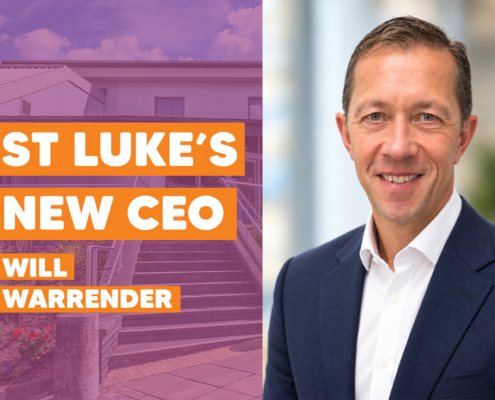 https://www.stlukes-hospice.org.uk/wp-content/uploads/2026/10/Will-Warrender-Annoucement-New-CEO-Blog-Header.jpg
733
1030
Charlie Carlyle
https://www.stlukes-hospice.org.uk/wp-content/uploads/2022/12/st-lukes-hospice-plymouth.svg
Charlie Carlyle2026-10-19 13:26:182026-10-19 13:26:37St Luke’s appoints new Chief Executive
https://www.stlukes-hospice.org.uk/wp-content/uploads/2026/10/Will-Warrender-Annoucement-New-CEO-Blog-Header.jpg
733
1030
Charlie Carlyle
https://www.stlukes-hospice.org.uk/wp-content/uploads/2022/12/st-lukes-hospice-plymouth.svg
Charlie Carlyle2026-10-19 13:26:182026-10-19 13:26:37St Luke’s appoints new Chief Executive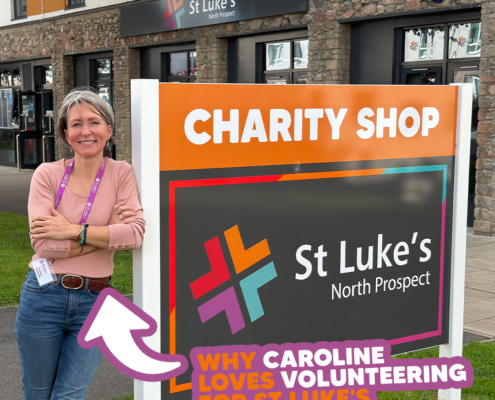 https://www.stlukes-hospice.org.uk/wp-content/uploads/2026/10/Volunteer-Caroline-October-2026-1080.jpg
1080
1080
Charlie Carlyle
https://www.stlukes-hospice.org.uk/wp-content/uploads/2022/12/st-lukes-hospice-plymouth.svg
Charlie Carlyle2026-10-18 08:00:552026-10-15 13:28:35Connection, community and giving back: Why Caroline loves volunteering for St Luke’s
https://www.stlukes-hospice.org.uk/wp-content/uploads/2026/10/Volunteer-Caroline-October-2026-1080.jpg
1080
1080
Charlie Carlyle
https://www.stlukes-hospice.org.uk/wp-content/uploads/2022/12/st-lukes-hospice-plymouth.svg
Charlie Carlyle2026-10-18 08:00:552026-10-15 13:28:35Connection, community and giving back: Why Caroline loves volunteering for St Luke’s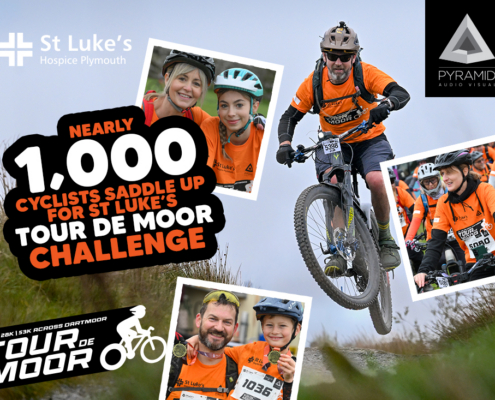 https://www.stlukes-hospice.org.uk/wp-content/uploads/2026/10/TDM26-Post-Event-Blog-Header.jpg
733
1030
Charlie Carlyle
https://www.stlukes-hospice.org.uk/wp-content/uploads/2022/12/st-lukes-hospice-plymouth.svg
Charlie Carlyle2026-10-12 19:57:192026-10-12 20:17:48Nearly 1,000 cyclists saddle up for St Luke’s Tour de Moor challenge
https://www.stlukes-hospice.org.uk/wp-content/uploads/2026/10/TDM26-Post-Event-Blog-Header.jpg
733
1030
Charlie Carlyle
https://www.stlukes-hospice.org.uk/wp-content/uploads/2022/12/st-lukes-hospice-plymouth.svg
Charlie Carlyle2026-10-12 19:57:192026-10-12 20:17:48Nearly 1,000 cyclists saddle up for St Luke’s Tour de Moor challenge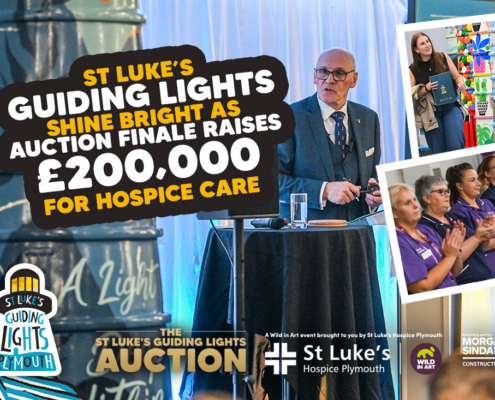 https://www.stlukes-hospice.org.uk/wp-content/uploads/2026/10/Post-Auction-Blog-Header.jpg
733
1030
Charlie Carlyle
https://www.stlukes-hospice.org.uk/wp-content/uploads/2022/12/st-lukes-hospice-plymouth.svg
Charlie Carlyle2026-10-05 13:52:312026-10-05 13:52:31Our Guiding Lights shine bright as auction finale raises £200,000 for hospice care
https://www.stlukes-hospice.org.uk/wp-content/uploads/2026/08/Daves-Story-Blog-Header.jpg
733
1030
Charlie Carlyle
https://www.stlukes-hospice.org.uk/wp-content/uploads/2022/12/st-lukes-hospice-plymouth.svg
Charlie Carlyle2026-09-02 11:32:112026-09-02 11:48:26Dave’s reason to ride: Making every mile matter
https://www.stlukes-hospice.org.uk/wp-content/uploads/2026/10/Post-Auction-Blog-Header.jpg
733
1030
Charlie Carlyle
https://www.stlukes-hospice.org.uk/wp-content/uploads/2022/12/st-lukes-hospice-plymouth.svg
Charlie Carlyle2026-10-05 13:52:312026-10-05 13:52:31Our Guiding Lights shine bright as auction finale raises £200,000 for hospice care
https://www.stlukes-hospice.org.uk/wp-content/uploads/2026/08/Daves-Story-Blog-Header.jpg
733
1030
Charlie Carlyle
https://www.stlukes-hospice.org.uk/wp-content/uploads/2022/12/st-lukes-hospice-plymouth.svg
Charlie Carlyle2026-09-02 11:32:112026-09-02 11:48:26Dave’s reason to ride: Making every mile matter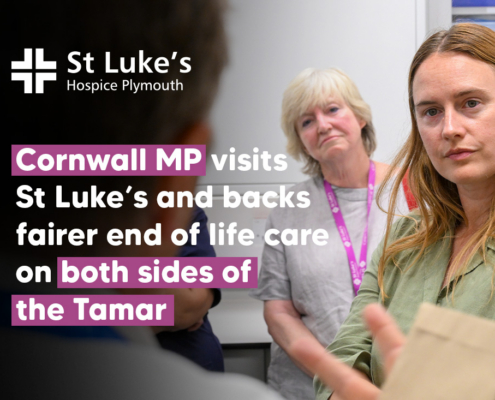 https://www.stlukes-hospice.org.uk/wp-content/uploads/2026/08/MP-Visit-Blog-Header.jpg
733
1030
Jesse Cambridge
https://www.stlukes-hospice.org.uk/wp-content/uploads/2022/12/st-lukes-hospice-plymouth.svg
Jesse Cambridge2026-09-02 10:00:312026-09-02 15:41:55Anna Gelderd MP backs fairer end-of-life care
https://www.stlukes-hospice.org.uk/wp-content/uploads/2026/08/MP-Visit-Blog-Header.jpg
733
1030
Jesse Cambridge
https://www.stlukes-hospice.org.uk/wp-content/uploads/2022/12/st-lukes-hospice-plymouth.svg
Jesse Cambridge2026-09-02 10:00:312026-09-02 15:41:55Anna Gelderd MP backs fairer end-of-life care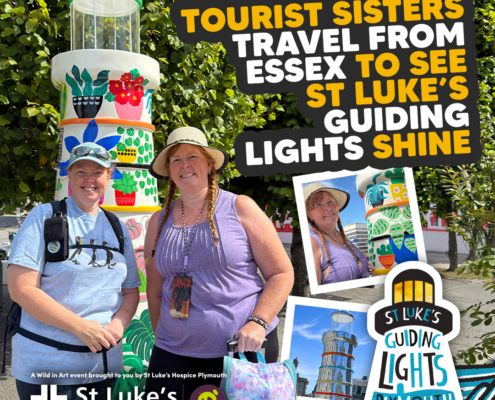 https://www.stlukes-hospice.org.uk/wp-content/uploads/2026/08/Guiding-Lights-Tourist-Article-August-2026-108057.jpg
1080
1080
Charlie Carlyle
https://www.stlukes-hospice.org.uk/wp-content/uploads/2022/12/st-lukes-hospice-plymouth.svg
Charlie Carlyle2026-08-28 09:00:582026-08-26 20:37:30Tourist sisters travel from Essex to see Guiding Lights shine
https://www.stlukes-hospice.org.uk/wp-content/uploads/2026/08/Guiding-Lights-Tourist-Article-August-2026-108057.jpg
1080
1080
Charlie Carlyle
https://www.stlukes-hospice.org.uk/wp-content/uploads/2022/12/st-lukes-hospice-plymouth.svg
Charlie Carlyle2026-08-28 09:00:582026-08-26 20:37:30Tourist sisters travel from Essex to see Guiding Lights shine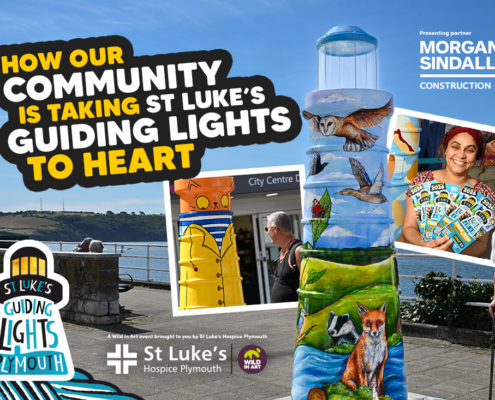 https://www.stlukes-hospice.org.uk/wp-content/uploads/2026/08/GL-One-Month-On-Blog-Header-August-2026.jpg
733
1030
Charlie Carlyle
https://www.stlukes-hospice.org.uk/wp-content/uploads/2022/12/st-lukes-hospice-plymouth.svg
Charlie Carlyle2026-08-24 17:06:302026-09-02 15:37:47How our community is taking St Luke’s Guiding Lights to heart
https://www.stlukes-hospice.org.uk/wp-content/uploads/2026/08/GL-One-Month-On-Blog-Header-August-2026.jpg
733
1030
Charlie Carlyle
https://www.stlukes-hospice.org.uk/wp-content/uploads/2022/12/st-lukes-hospice-plymouth.svg
Charlie Carlyle2026-08-24 17:06:302026-09-02 15:37:47How our community is taking St Luke’s Guiding Lights to heart


 Record-breaking 2,500 put their best foot forward for hospice care